
The $890 Billion Round Trip
Supply chains have spent years perfecting the forward journey getting product to the customer faster and cheaper than ever. The return journey got almost none of that attention. Yet that's exactly where a growing share of margin now leaks out: in the slow, manual, largely invisible process of getting a returned or received item back to usable stock.
The economics of the round trip
The scale is hard to overstate. According to the National Retail Federation and Happy Returns, U.S. consumers returned about $890 billion of goods in 2024 roughly 16.9% of everything sold, and more than double the $309 billion (8.1%) returned in 2019. Online return rates run higher still, and in some categories reach 30–40%.
Each of those items has to come back, be assessed, and be sent somewhere and that's expensive. Processing a single return costs retailers an estimated 30% of the item's original price, and the industry loses more than $100 billion a year to return-related costs. The forward supply chain is a science the reverse one is still, in most operations, a back-room manual process.
Why return-to-stock is so hard
Return-to-stock is deceptively complex. Every item that comes back triggers the same questions what is it, what condition is it in, and what should happen to it next and today those questions are answered by hand:
- Identification is manual. Someone reads a label, a barcode, or a packing slip and keys it in.
- Condition is graded by eye. Two people grade the same item differently, and disputes follow.
- Disposition is a judgment call. Restock, refurbish, liquidate, or scrap each with a very different recovery value.
- There's no real-time visibility. Returns pile up in a corner, and no one can say what's in the backlog or what it's worth.
And the clock is always running: the longer an item sits unprocessed, the more its recovery value decays from full resale to markdown to salvage.
The cost of a slow, blind returns process
Like dwell time in the yard, the real cost of returns hides in the aggregate. Every unopened box that sits for a week. Every item graded inconsistently. Every mis-sorted SKU. Every restock decision made late. Individually they're small; together they are one of the largest, least-measured sources of avoidable cost in the business and because no single one is big enough to flag, most operations never add them up.
What 'good' looks like
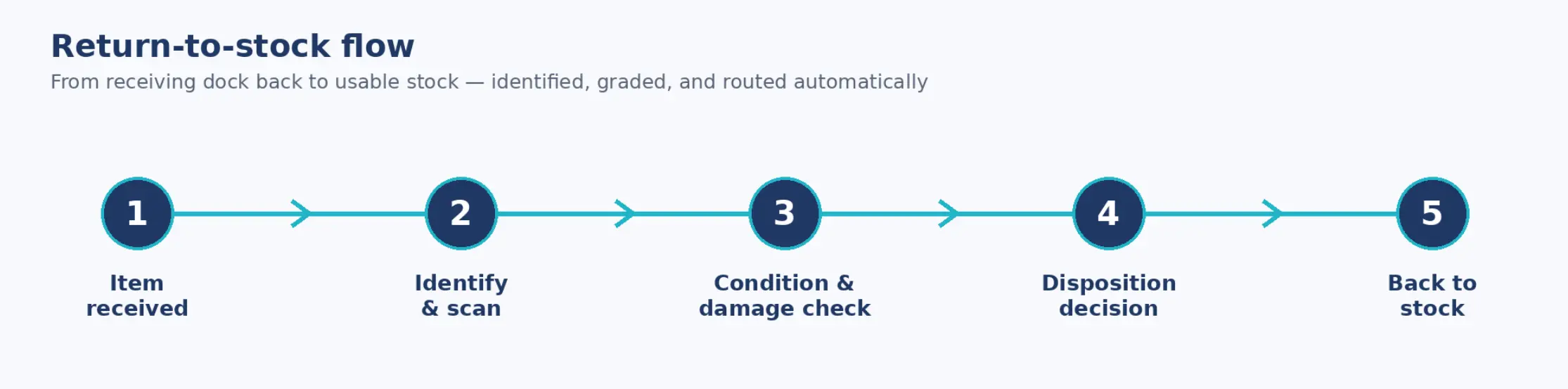
Picture the reverse journey done right. An item arrives at the receiving dock. It's identified automatically SKU, lot, origin without anyone keying it in. Cameras capture its condition and any damage the moment it lands, creating an objective record. A disposition decision is made in real time: back to stock, to refurbishment, or to liquidation. Usable inventory is available again in hours, not weeks, and the returns backlog is a live number instead of a mystery pile.
That's the difference between a returns process that reacts and one that recovers value on purpose.
Traditional returns vs. Vision AI-powered return-to-stock
| Traditional returns | Vision AI-powered return-to-stock |
|---|---|
| Manual receiving logs | Automated item identification on arrival |
| Condition graded by eye, inconsistently | Objective, image-based condition and damage capture |
| Returns pile up awaiting a decision | Disposition decided in real time restock, refurbish, or liquidate |
| No visibility into the returns backlog | Live returns inventory and status |
| Recovery value decays while items sit | Faster return-to-stock preserves recovery value |
From backlog to recovery
The shift that makes this possible is Physical AI the combination of computer vision, AI, and real-time automation applied to physical operations. Instead of asking people to inspect, grade, and log every returned item by hand, Physical AI turns the cameras on the receiving line into an engine that identifies items, captures their condition, and feeds an instant, consistent disposition decision. The returns area stops being a black box and becomes a measured, managed part of the operation.
This is the approach behind KoiReader. Applied to return-to-stock, KoiReader identifies and grades received items automatically, documents condition and damage objectively, and routes each item to its best outcome feeding live returns inventory and status into the WMS, ERP, and yard systems teams already run.
Proof in production
I's already in the field. At a national food-services and facilities operator, returned and received items that once queued for manual inspection are now identified and condition-checked automatically on arrival, with disposition decided in real time turning a slow, blind backlog into a fast, visible recovery process from receiving dock to shelf.
The bottom line
Returns are no longer an edge case; at nearly 17% of sales they're a structural cost of doing business. The companies that treat the reverse journey the way they treat the forward one instrumented, automated, and measured will recover more value from every item that comes back.
The next margin battleground isn't getting product out the door. It's what happens when it comes back.


KoiVision® is the Logistics, Supply Chain, and Industrial Automation Newsletter where we highlight how you can reimagine operations through Deep Tech Insights.
Written by
Padmaja Santhanam
Director of Marketing, KoiReader Technologies
Dated